Chapter 2 – Namaste
Unit 2 — Cultural Insight
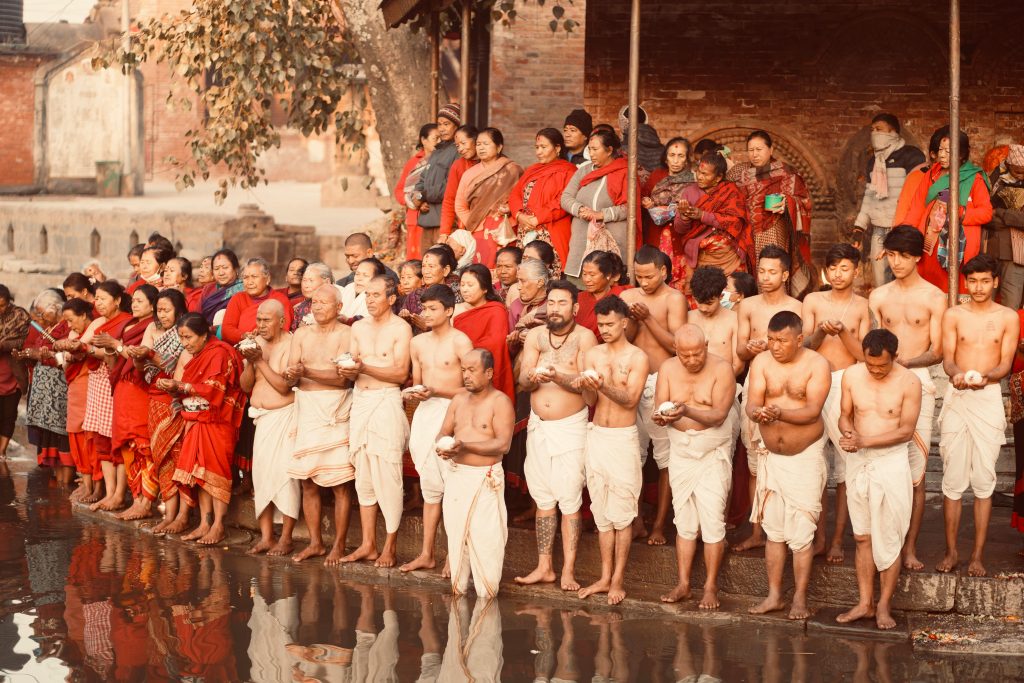
Respect, hands, and feet (everyday etiquette)
In Nepal, everyday politeness is often shown through small actions. Greeting respectfully, using the right hand in exchanges, and being mindful of feet are common ways people communicate respect—especially toward elders, teachers, and senior community members.
Greeting
The most common greeting in Nepali is नमस्ते (namaste). It is suitable in a wide range of social contexts and is also frequently used as a polite farewell. A more formal alternative is नमस्कार (namaskār), which may be used in speeches, public settings, or when a speaker wishes to convey a higher degree of respect. In urban and international professional environments, handshakes are also common, although नमस्ते (namaste) remains the most broadly acceptable default greeting.
Unlike English, Nepali does not generally employ distinct routine greetings such as “good morning,” “good afternoon,” “good evening,” or “good night” when meeting others. Instead, नमस्ते (namaste) commonly functions as an all-purpose greeting across the day. Although literal expressions such as शुभ प्रभात (śubha prabhāt) and शुभ रात्रि (śubha rātri) are available in the language, they are relatively uncommon in everyday spoken interaction. In ordinary usage, नमस्ते (namaste) is the most natural and conventional form.
Respect in groups
Respect for elders and teachers is a strong social norm. In a group setting, people often greet elders first and may speak more formally with someone older or higher-status.
Hands and exchanging items
When giving or receiving money, food, gifts, or documents, it is polite to use the right hand (or both hands together). In many contexts, using only the left hand can feel discourteous because it may be viewed as less “clean.”
Feet and personal space
Feet are symbolically sensitive in many settings. People usually avoid touching someone with their feet, pointing the soles of their feet toward others, stepping over someone’s outstretched legs, or sitting in a way that aims shoes at people.
If you make a mistake
If you accidentally bump someone with your foot, a brief apology is appropriate. Many people also make a small respectful gesture (lightly touching the area and then touching the forehead) to show the contact was unintentional.