Chapter 1 Introduction to Pathophysiology; Cellular Responses to Stress, Injury, and Aging
Section 3 Drug Development and Pharmaceutical Trials
Zoë Soon
How are new medications and treatments developed and tested before being approved for use? Understanding this process provides important insight into why finding cures for disease such as cancer is so difficult, costly, and time-consuming. Pharmaceutical companies fund approximately 80% of health research, with the rest funded by philanthropists and governments (including universities).
The Four Stages of Drug Development
Stage One: Creating or Isolating the Compound
At this stage, a candidate compound is either:
- Created through combinatorial chemistry: A synthetic compound is developed, informed by knowledge of disease-specific cellular targets and what chemical properties (size, shape, charge, enzymatic qualities) are desired. Frequently the process of synthetic compound design is informed by detailed knowledge of disease-specific cellular targets that this new medical compound is being designed to interact with, and what type of interaction would be beneficial.
- Purified from natural sources: A natural source (e.g., plant) suspected to have medicinal properties is analyzed to isolated and identify the specific compound(s) of interest. Purification is important because plants contain thousands of compounds, some of which may be harmful.
Stage Two: Cell Testing
Purified compounds are tested on animal or human cell lineages grown in Petri dishes (e.g., epithelial, muscle, or neural cells, including lineages that mimic disease conditions). Dose-dependent studies are performed to assess: whether cells are harmed, and whether the compound is effective in offsetting disease qualities in the cells. If the compound is found to be harmful, researchers return to Stage One.
Stage Three: Animal Testing or Organ-on-a-Chip Testing
For many decades, drug approval in Canada and other countries have had in place legal requirements that require that pharmaceutical compounds must be tested in animal models to evaluate toxicity, pharmacokinetics and safe dosage levels before being used in human studies. Therefore lab-bred mice and rats have been used to assess safety and ensure effectiveness. These mammals are chosen as they are genetically and physiologically similar to humans sharing approximately 95% of the same genes. The known genome, large litter sizes, short gestation times (~20 days) and frequent reproduction allow for sufficient sample sizes and robust testing efficacy and statistical analysis. As medical laboratory science continues to advance, the goal is eventually completely replace animal testing in Stage 3 through the use of utilizing human organ-on-a-chip (OoC) technology. If successful in mitigating disease-like conditions, with minimal side effects, the compound moves to Stage Four.
Stage Four: Human Clinical Trials
The compound is tested in a double-blind study with a small group of humans affected by the disease, who have consented to participate. If successful, the study is expanded to larger groups. Important variables examined at this stage include responses across different age groups, biological, sexes, and other key factors. Different dosages and modes of administration (oral, injection) may also be tested.
What is a Double-Blind Study?
In a double-blind study, two conditions are in place once participants have been thoroughly informed and consented to the study.
1) The person receiving the drug or treatment does not know whether they are receiving the new drug or a placebo / sham treatment.
2) The health practitioner administering the treatment also does not know whether they are giving the experimental drug or the placebo / sham treatment.
This design controls for the placebo effect – the well-documented phenomenon in which approximately 30% of people receiving a placebo report feeling better, likely due to positive expectations and the comfort of being cared for. Studies have shown that even being in the presence of a health care practitioner can stimulate a placebo effect. Therefore, a new drug is only considered effective if its outcomes exceed those produced by the placebo / sham treatment.
Placebo Drugs and Sham Treatments
| Placebo Drug | Most often the current best available drug (not a sugar pill) is used as the placebo so that participants continue to receive the best possible treatment during the study. This is more ethical and allows the experimental drug to be compared against the current standard of care. If a drug doesn’t currently exist, a sugar pill may be used. |
| Sham Treatment | A mock treatment that mimics the actual treatment without producing the therapeutic effect (e.g., sham acupuncture needles that look and feel real but do not penetrate the skin). |
Why is it Unethical to Treat All Patients with Placebos?
Even though placebos make ~30% of people feel better, the positive effects do not last. After weeks to months, patients begin to feel the effects of the disease again – because the disease has not been treated. Placebos do not address the underlying pathophysiology.
Movie Time: Click here to watch the 4 minute TEDEx animation: The Power of the Placebo Effect and then answer the following question:
* Personalized Medicine Development in the Futures
Organ-on-a-chip (OoC) technology enables scientists to grow patient-derived organoids — tiny proxy organs — in 3D chip structures under physiological conditions, allowing personalized treatment testing in the lab. This is especially promising for cancer, where tumor characteristics vary widely between patients; testing organoids against multiple treatments could fast-track individualized therapy. Though currently costly, integrating robotics into the OoC process may make it more accessible for both drug discovery and personalized medicine.
Why Most New Drugs Fail
Unfortunately, most new drugs are discarded after Stage One or Stage Two for one of three reasons:
a) They don’t work.
b) They cause harm.
c) They are not better than existing drugs, and are more expensive to produce.
Special Cases in Drug Approval
| Fast-Tracked | Very rarely, a new drug skips the large-scale human study and is immediately approved for use when it works so well that it is deemed most ethical to make it available immediately. This occurred with AZT (azidothymidine), an antiviral used in HIV treatment. |
| Off-Label | A drug that has completed all testing stages and has been found effective for a different condition than what it was initially designed for. |
Examples of Off-Label Drug Use
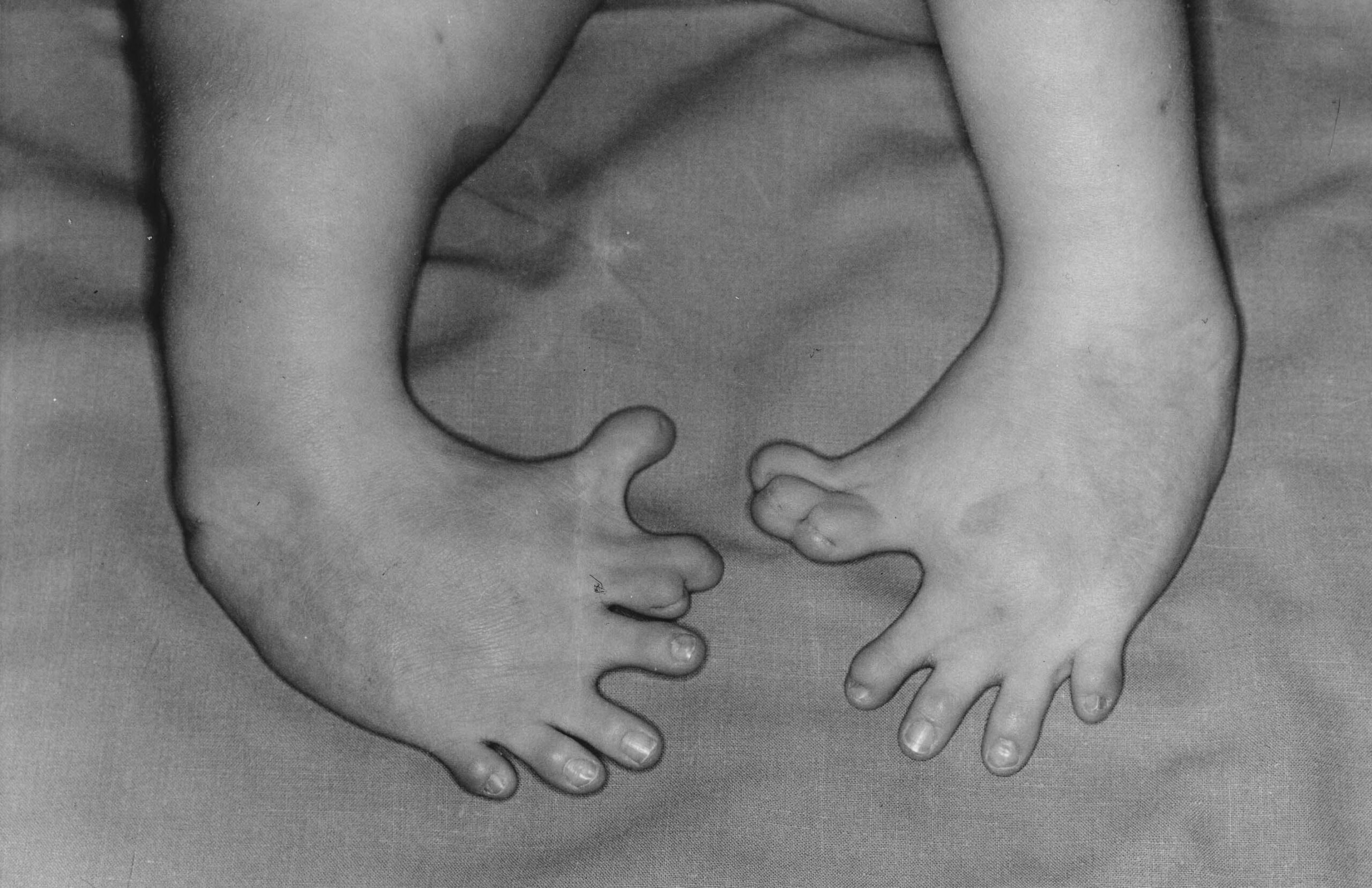
Thalidomide: Originally developed in the 1950s in Germany to alleviate morning sickness in pregnant women. It was later discovered to cause serious congenital defects – including blindness, deafness, cleft palate, and limb defects – and miscarriages. It took approximately six years to remove it from the market during which time thousands of babies across Canada, Germany, the United Kingdome, the US, and Europe were affected. Today thalidomide has been found effective in certain cancer treatments.
Viagra: Originally developed as a vasodilator for heart disease (to dilate coronary arteries). Researchers discovered it also caused vasodilation of penile arteries. After completing all testing stages and being deemed safe and effective, its use for erectile dysfunction is considered an off-label application.
∗ Fun Fact: Natural Compounds as Medicine
Antibiotics are antibacterial agents most often produced naturally by other microorganisms (including fungi/yeast). Humans have found it useful to mass-produce some of these naturally-occurring antibiotics – such as penicillin – to combat bacterial infections, which can otherwise be fatal.
Penicillin was discovered in 1928 by Scottish bacteriologist Alexander Fleming when upon returning from holiday, he found an uncovered petri dish containing Staphylococcus bacteria had been contaminated with Penicillium notatum mold. The bacteria around the mold was dead and this led scientists at Oxford University to purify the active compound in 1940. Large-scale production of penicillin began in 1941 and has saved millions of lives since that time.
This is a powerful example of a natural compound being harnessed for medicine.
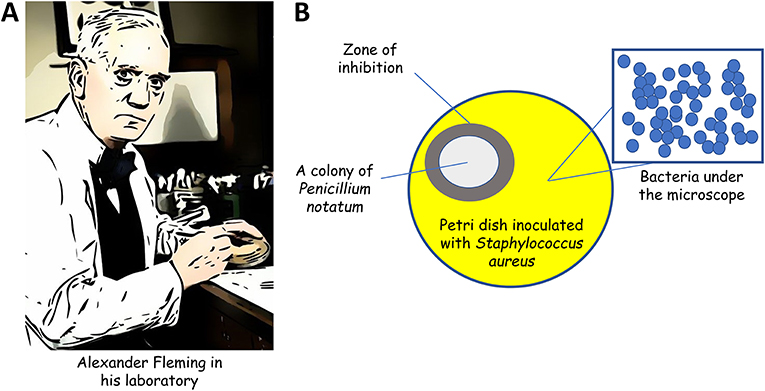
(B) Fleming observed that a colony of a fungus (Penicillium notatum) contaminated a Petri dish that was inoculated with S. aureus, a dangerous bacterial pathogen. Interestingly, S. aureus was unable to grow in the area surrounding the colony of P. notatum. Fleming deduced that the fungus was producing something that killed S. aureus in the zone of inhibition.
How to Assess Medical Information? Separating Fact from Fiction
Watch the following short video for important tips before moving to the next section:
Watch the following short video for important tips before moving to the next section:
TEDEx How to Hack HeadLines – Fake medical news or real?
Video Follow-Up Questions:
What is healthium? Does it reduce cholesterol?
Does chocolate reduce stress?
How do you determine whether news about medical research is believable? Ask yourselves these questions:
Has the research been submitted for peer-evaluation? Has the research been found to be reproducible? Was a large enough sample size (# of people) used to ensure robust statistical analysis is possible?
What is that actual difference? Is the difference/cure/alleviation of symptoms statistically significant? Were there negative side effects?
Has this been proven to be a short-term effect or long-term effect? How long?
Was the study double blind? Has it been reproduced by another research team? Was this study done in humans or mice or fish etc.?
.
Media Attributions
- Private: thalidomide_birth_defects © Otis Historical Archives National Museum of Health and Medicine is licensed under a CC BY (Attribution) license
- Alexander Fleming © Letek M (2020) Alexander Fleming, The Discoverer of the Antibiotic Effects of Penicillin. Front. Young Minds. 8:159. doi: 10.3389/frym.2019.00159 is licensed under a CC0 (Creative Commons Zero) license