Chapter 2 Innate and Adaptive Immunity: From Cell Defense to Tissue Repair
Section 7: T and B Lymphocyte Development and Selection
Zoë Soon
T Cell Development and Selection
T cells, arise from bone marrow hematopoietic cells and migrate to the thymus to mature through three stages.
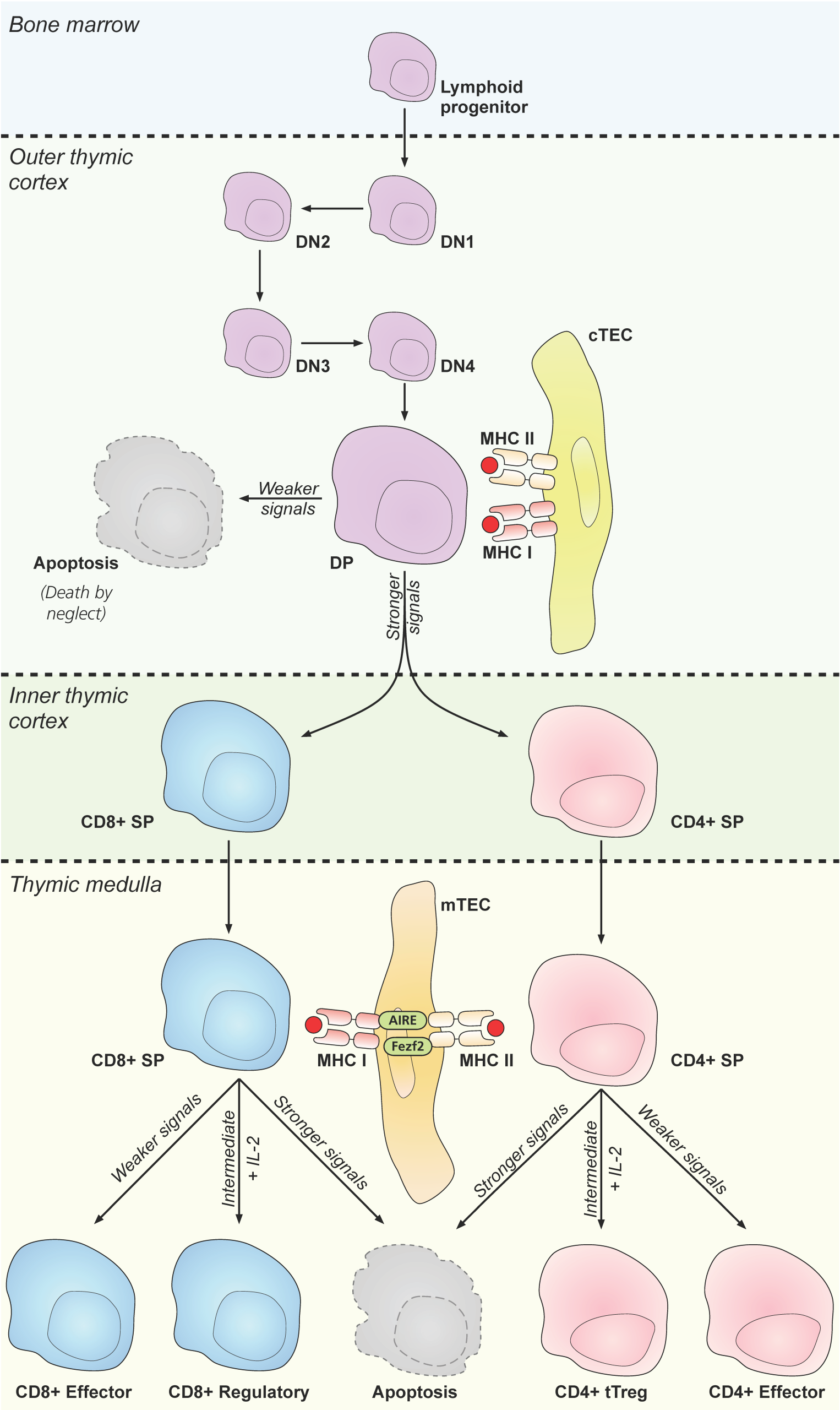
1. TCR Production: In the thymic cortex, T cells undergo somatic recombination to express a unique and functional T Cell Receptor (TCR) and are then nurtured; those without a functional TCR undergo apoptosis (‘death by neglect’).
2. Positive Selection: In the next step of maturation, termed positive selection, the T cells encounter cortical thymocytes that display Major Histocompatibility Complex (MHC) molecules (self identity transmembrane protein complexes). T cells that bind weakly or moderately to these MHC are chosen for further maturation, while those that do not bind or bind too strongly are eliminated. At this point in time, the surviving T cells commit to expressing either CD8 or CD4 receptors before entering the thymic medulla, where negative selection occurs.
3. Negative Selection: T cells are exposed to medullary thymic cells and APCs that are displaying a large array of self-peptides on their MHC molecules. T cells that bind too strongly are induced to undergo apoptosis to prevent autoimmunity.
Positive and Negative Selection: Preventing Autoimmunity
During Positive Selection in the Thymic Cortex:
| CD4+ T cells | Those that bind to thymic self-peptides displayed on MHC Class II molecules (MHC-II) are nurtured and develop CD4+ receptors → Positive Selection.
Those that either do not bind or bind too strongly to thymic self-peptide-MHC-II complexes undergo apoptosis (‘death by neglect’, preventing autoimmunity). |
| CD8+ T cells | Those that bind to thymic self-peptides displayed on MHC Class I (MHC-I) are nurtured and develop CD8+ receptors → Positive Selection.
Those that either do not bind or bind too strongly to self MHC-I undergo apoptosis (‘death by neglect’, preventing autoimmunity). |
During Negative Selection in the Thymic Medulla:
| CD4+ T cells | Those that weakly bind self-peptides displayed on MHC-II of APCs mature into CD4+ Effectors (Helper T cells).
Those binding moderately become CD4+ Regulatory T (Treg) cells that suppress effector T cell proliferation. Those that strongly bind self-peptides displayed on MHC-II of APCs undergo apoptosis (‘death by neglect’, preventing autoimmunity). |
| CD8+ T cells | Those that weakly bind self-antigens displayed on MHC-I of APCs mature into CD8+ Effectors (Cytotoxic T cells).
Those binding moderately become CD8+ Regulatory T cells. Those that strongly bind self-antigens displayed on MHC-I of APCs undergo apoptosis (‘death by neglect’, preventing autoimmunity). |
*Note: MHC (Major Histocompatibility Complex) proteins were previously known as HLA (Human Leukocyte Antigens).
MHC Class I are found on almost all nucleated cells in your body, and present normal antigens from self-proteins and will also present abnormal/foreign antigens when the cell is compromised.
MHC Class II are expressed only by APCs which include macrophages, dendritic cells, and B cells and are used to present phagocytosed foreign antigens to activate immune cells.
After negative selection, the T cells are now self-restricted and self-tolerant naïve T cells that can safely leave the thymus and enter the bloodstream and continuously recirculate through secondary lymphoid organs (like the spleen, lymph nodes, and tonsils) to patrol for foreign antigens. T cells are self-restricted meaning they bind foreign antigens only when presented on MHCs. T cells are self-tolerant meaning that T cells will not be activated by self-antigens.
B Cell Development and Selection
B cell development is similar to T cell development, in that B cells arise in the bone marrow from hemopoietic stem cells and through somatic recombination each develop a unique B cell receptor (BCR). The B cells then undergo both positive and negative selection, ensuring that: (1) BCRs are functional and that (2) B cells do not bind to self-antigens. B cells that either lack a functioning BCR or bind to self-antigens are induced to undergo apoptosis. The surviving B cells travel to the spleen, mature into self-tolerant naïve B cells that then migrate to and populate lymphatic tissues.
Media Attributions
- A figure depicting the process of T cell / thymocyte positive and negative selection in the thymus © Gwilz is licensed under a CC BY-SA (Attribution ShareAlike) license