Home to the Living Goddess Tradition
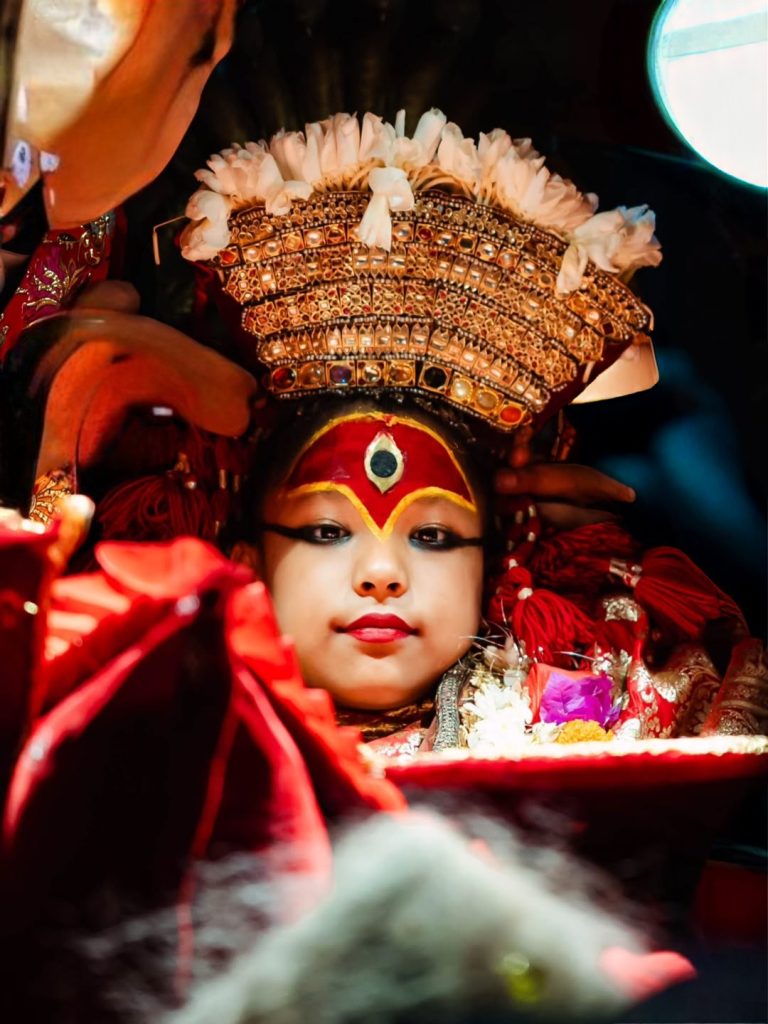
One of Nepal’s most distinctive cultural and religious traditions is the कुमारी (kumārī) tradition. In this tradition, a young pre-pubescent girl is revered as a living goddess. The Nepali word कुमारी (kumārī) means “virgin girl,” and the कुमारी (kumārī) is believed to embody divine female power, देवी (dewī).
In Kathmandu, the Royal Kumari is especially honoured as the living presence of Taleju Bhawani. The tradition is respected by both Hindu and Buddhist communities, reflecting Nepal’s long history of religious coexistence and cultural blending.
Kumari Ghar and the Kathmandu Valley
The best-known कुमारी (kumārī) lives in कुमारी घर (kumārī ghar) in Basantapur, near Kathmandu Durbar Square. This historic residence is an important part of the cultural landscape of the Kathmandu Valley.
Although the Kathmandu कुमारी (kumārī) is the most famous, similar traditions also exist in other Newar towns, including Patan and Bhaktapur. This shows that the कुमारी (kumārī) is not only an individual religious figure. She is also part of a broader Kathmandu Valley tradition.
Selection and Sacred Role
The selection of a कुमारी (kumārī) follows strict ritual and cultural criteria. In Kathmandu, the girl is traditionally chosen from the Shakya community of the Newar Buddhist population.
Once selected, she is worshipped as a deity until she reaches puberty. At that point, her sacred role ends, and a new कुमारी (kumārī) is chosen. In this way, divine presence is understood as dwelling temporarily in the child rather than permanently belonging to one individual.
Indra Jatra and Public Celebration
The कुमारी (kumārī) tradition becomes especially visible during इन्द्र जात्रा (indra jātrā), one of Kathmandu’s most important annual festivals. During this celebration, large crowds gather around Kathmandu Durbar Square and the surrounding streets to witness the chariot procession of the Living Goddess.
The कुमारी (kumārī) is carried through the city in a ceremonial procession. The event includes music, ritual performances, and other sacred chariots. For many devotees, seeing the कुमारी (kumārī) during इन्द्र जात्रा (indra jātrā) is both a religious blessing and a deeply meaningful cultural experience.
Cultural Meaning
What makes the कुमारी (kumārī) tradition especially striking is that it gives visible human form to the sacred. Divine power is not encountered only through temple images, statues, or religious texts. It is also understood as present in a living child.
For this reason, the कुमारी (kumārī) holds a unique place in Nepal’s cultural imagination. She is a religious figure, a ceremonial presence, and a symbol of the Kathmandu Valley’s living heritage.
For learners of Nepali language and culture, the कुमारी (kumārī) tradition offers an important example of how history, religion, ritual, and everyday life remain closely connected in Nepal.